The Map Is Not the Territory. The Algorithm Is Not the Life.
Algorithms to Live By makes a beautiful case that human problems resemble computational ones — and quietly skips the step that would determine whether resemblance is enough.
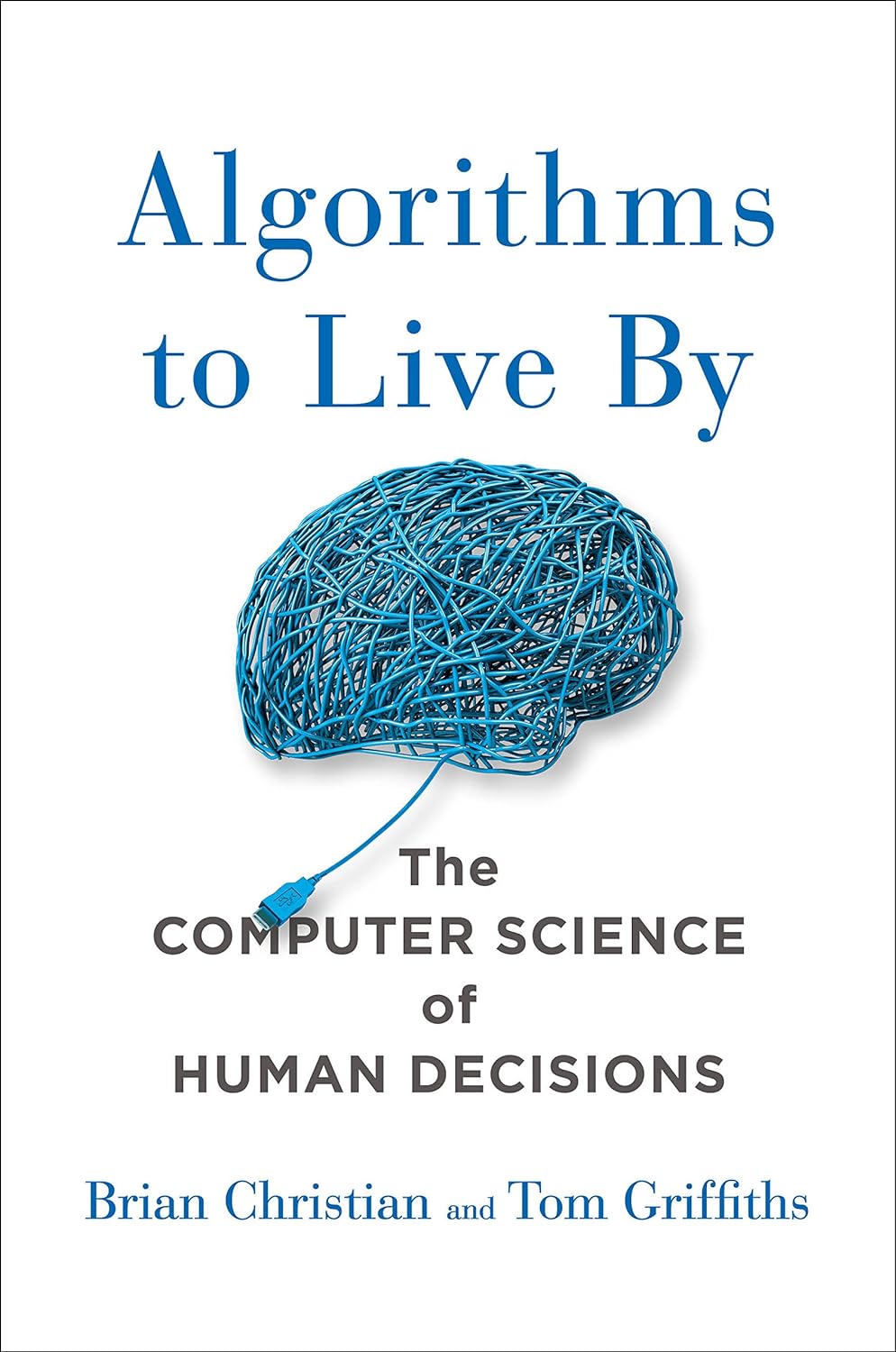
Brian Christian and Tom Griffiths are unusually honest practitioners of a genre that rewards dishonesty. Most popular science books of this kind take a powerful formal result, sand off its assumptions, and hand the reader a prescription dressed as a proof. Christian and Griffiths flag the assumptions. They acknowledge the gap between formal optimality and human application. They resist the worst tendencies of the form.
And yet the book's organizing premise is wrong in a way that matters, and the wrongness is harder to see precisely because of the authors' scrupulousness. They are careful enough to earn the reader's trust. Then they use that trust to make a move they have not quite earned: from "this problem resembles that algorithm" to "you should apply this algorithm to your life."
That move is not a footnote error. It is the error. And tracing it tells us something important about what education in the age of machines should actually be building — and what it persistently fails to.
The Slip That Happens in Every Chapter
The book's premise is genuinely illuminating in its narrow form. Human beings do face versions of optimal stopping problems. We do navigate explore-exploit trade-offs. We do confront scheduling conflicts. The computational framing reveals real structure in situations that previously seemed intractably messy. This is worth something.
The 37% rule emerges from the secretary problem. The secretary problem specifies its conditions precisely: you observe candidates serially, you cannot return to a rejected candidate, you have no cardinal information about quality, and your objective is to find the single best option. Given those conditions, reviewing 37% of the field and then selecting the next candidate who exceeds everything you've seen is provably optimal.
Now you are searching for an apartment.
Can you revisit a rejected apartment? Sometimes. Do you have cardinal information — price, square footage, distance to work — alongside rank? Always. Is your objective finding the single best apartment in the market, or finding one good enough to sign a lease? Almost certainly the latter. Relax any of the secretary problem's conditions — and in real apartment searches, all of them relax — and the prescription changes. Relax all of them and the 37% rule is not a useful approximation of optimal behavior. It is a solution to a different problem.
The book acknowledges this. In the footnotes. In the qualifications. Then it tells a story about someone who applied the 37% rule to their romantic life, and the reader absorbs the prescription. The qualifications evaporate in the narrative heat. This is the pattern, chapter after chapter: formal result, evocative story, prescription, qualifications that don't survive the chapter break.
An optimal algorithm is optimal for its problem specification. The step from "this algorithm solves problem P" to "you should apply this algorithm to your situation" requires establishing that your situation is actually an instance of P. That step is the hard one. It requires exactly the kind of judgment the book is ostensibly teaching. It is almost never taken. Instead it is gestured at, through examples close enough to seem convincing — and the reader, having been shown that formal structure exists in human situations, assumes it exists in their specific situation without checking.
Computation Is Something We Assign, Not Something We Find
The philosophical mistake underlying the book's prescriptions is worth naming precisely, because it recurs throughout and determines how much the empirical evidence can actually support.
When Christian and Griffiths say that the aging brain "implements" the explore-exploit trade-off — that elderly people's social pruning is the rational response to a foreshortened time horizon — they are making a categorization, not a discovery. "Computation" is observer-relative: it is assigned to a physical process by someone who chooses to interpret that process as implementing an algorithm. Stones falling off cliffs compute trajectories under the right interpretive frame. The brain is doing what it does. We are choosing to describe it computationally. That choice may be illuminating. It is not evidence that the brain's intrinsic operation is algorithmic in the sense that licenses the book's prescriptions.
The experiments by Tenenbaum and Griffiths — which showed that human predictions for movie grosses, congressional terms, and cake-baking times closely match Bayesian posteriors computed from real distributional data — are the book's strongest empirical claim, and they are genuinely striking. But notice precisely what they establish. They establish that humans carry well-calibrated priors in familiar domains, and that their predictions match Bayesian expectations after the fact. They do not establish that humans perform explicit Bayesian inference.
A stopped clock displays the correct time twice a day. We should not infer that it is computing the time. The behavioral match is real. The mechanistic claim is a further step that the evidence does not take.
This matters more than it might seem. The book's prescriptive program depends on the mechanistic claim. If the brain actually implements Bayesian inference, then improving your predictions means calibrating your priors — a specific, actionable intervention. If the brain merely produces outputs that sometimes match Bayesian predictions, the mechanism could be anything and the prescription evaporates. Behavioral conformity to a model is not the same as running the model. The book consistently treats them as equivalent.
Where the Book Accidentally Gets It Right
There is something the book gets profoundly right, and its authors may not fully appreciate what they have done.
The game theory chapters quietly dismantle the individualistic premise of everything that precedes them. The early chapters offer algorithms for individual optimization: how you should stop, explore, schedule, cache. Then the game theory chapters arrive to announce that many of the most consequential problems humans face — climate coordination, market bubbles, the tragedy of the commons, the prisoner's dilemma — are intractable at the individual level.
No amount of individually optimal scheduling prevents a commons from being grazed to destruction. No amount of individually calibrated Bayesian inference prevents an information cascade from sweeping away accurate beliefs. These are structural failures that require structural solutions. Mechanism design — changing the rules of the game rather than the strategies of the players — is the correct intervention. It operates entirely outside the individual optimization framework that dominates the first two-thirds of the book.
The concept of "computational kindness" that closes the book captures something real: framing problems in ways that lower the cognitive burden on others is a genuine social good, worth teaching explicitly. But the deeper implication is not drawn. Collective intelligence — the distributed epistemic systems that produce science, markets, and democratic deliberation — is not decomposable into better individual algorithms. It is emergent from the friction and coordination of minds in genuine relationship. The book cannot account for this, because it begins from the individual and never escapes it.
This is also, incidentally, what large language models cannot account for. They are trained on what we wrote, argued, and got wrong over centuries. They reflect our pattern-making back at us with extraordinary fidelity — linguistic, associative, logical in the narrow sense. What they cannot reflect is what happened between us: the collaborative friction that refined an idea, the trust that made knowledge transmissible, the stakes that gave wisdom its teeth. No training corpus captures the difference between knowing what Bayesian inference prescribes and knowing when to trust your priors.
The Educational Conclusion the Book Earns and Doesn't Draw
Algorithms to Live By is, among other things, a self-help book. And the self-help tradition has always been in tension with the kinds of intelligence that actually need developing.
The book teaches readers to recognize algorithmic structure in everyday situations. That is an underrated skill. It teaches the application of formal tools where formal conditions obtain. That is useful too. But the judgment required to know whether a problem's formal structure actually matches an available algorithm — the judgment that is doing all the work in the critical moments when the book catches itself — is not what the book teaches. It is what the book uses.
The 37% rule fails 63% of the time. The book says this, correctly, and frames it as comfort: even optimal strategies fail, so don't blame yourself. There is a different lesson available, and it is harder. Learning when a problem's formal structure matches an available algorithm requires judgment that no algorithm supplies. Recognizing that your apartment search is sufficiently serial and irreversible and rank-order-only to make the 37% rule applicable is not itself a computation. It is something else — call it practical wisdom, call it phronesis, call it the knowledge that knows when the map applies to the territory. It requires being situated in the world, with real stakes, real uncertainty, and a genuine investment in the outcome.
Stop training people to apply algorithms. Start training them to evaluate whether the algorithm fits. The former is increasingly automated. The latter is precisely what machines cannot do — not for lack of processing power, but because it requires being the kind of thing that has something to lose.
The book's best moments are not its algorithmic moments. They are the moments of judgment — when the authors notice that humans stop too early, that the assumptions have been violated, that mechanism design operates at a level the individual cannot reach. The book is most valuable not as a source of prescriptions but as a training ground for the attention that knows when to trust a proof and when to walk away from it.
The algorithm for that attention has not been written.
I suspect it cannot be.
SUMMARY
This piece takes Algorithms to Live By seriously enough to follow its argument to where it breaks. The critique is not that computation is the wrong metaphor for human cognition — the book demonstrates genuine illumination there — but that the move from structural resemblance to prescriptive equivalence is a step the book consistently skips. The 37% rule is optimal under specific conditions. Real apartment searches relax every one of them. The reader absorbs the prescription anyway, because the story is compelling and the qualifications are in the footnotes. That pattern — formal result, evocative example, absorbed prescription, vanished caveats — is the book's organizing error and the piece names it without softening it.
The Searle point about observer-relative computation earns its place because it is the philosophical foundation of the error: computation is assigned to a process, not discovered in it. The Tenenbaum-Griffiths experiments are treated with genuine respect — the behavioral match they demonstrate is real and striking — but the piece draws the line at the mechanistic inference. Behavioral conformity to a Bayesian model is not the same as running Bayesian inference, and the prescriptive program depends on the distinction.
The game theory section is treated as the book's accidental best argument: collective failure is not decomposable into individual optimization, and mechanism design operates at a level the individual cannot reach. The book opens this door and does not walk through it. The piece asks the reader to notice what is on the other side.
The educational conclusion is where the piece places its moral weight. The judgment required to evaluate whether a problem matches an algorithm is not itself algorithmic — and it is exactly what education persistently fails to build, because it is exactly what cannot be automated. The piece ends where the genre of prescriptive self-help cannot: at the limit of what a proof can do, and the question of what must come after it.