The Comfortable Pessimist's Silence
Melanie Mitchell diagnosed AI's real limits with precision — then refused to follow her own argument to where it leads.
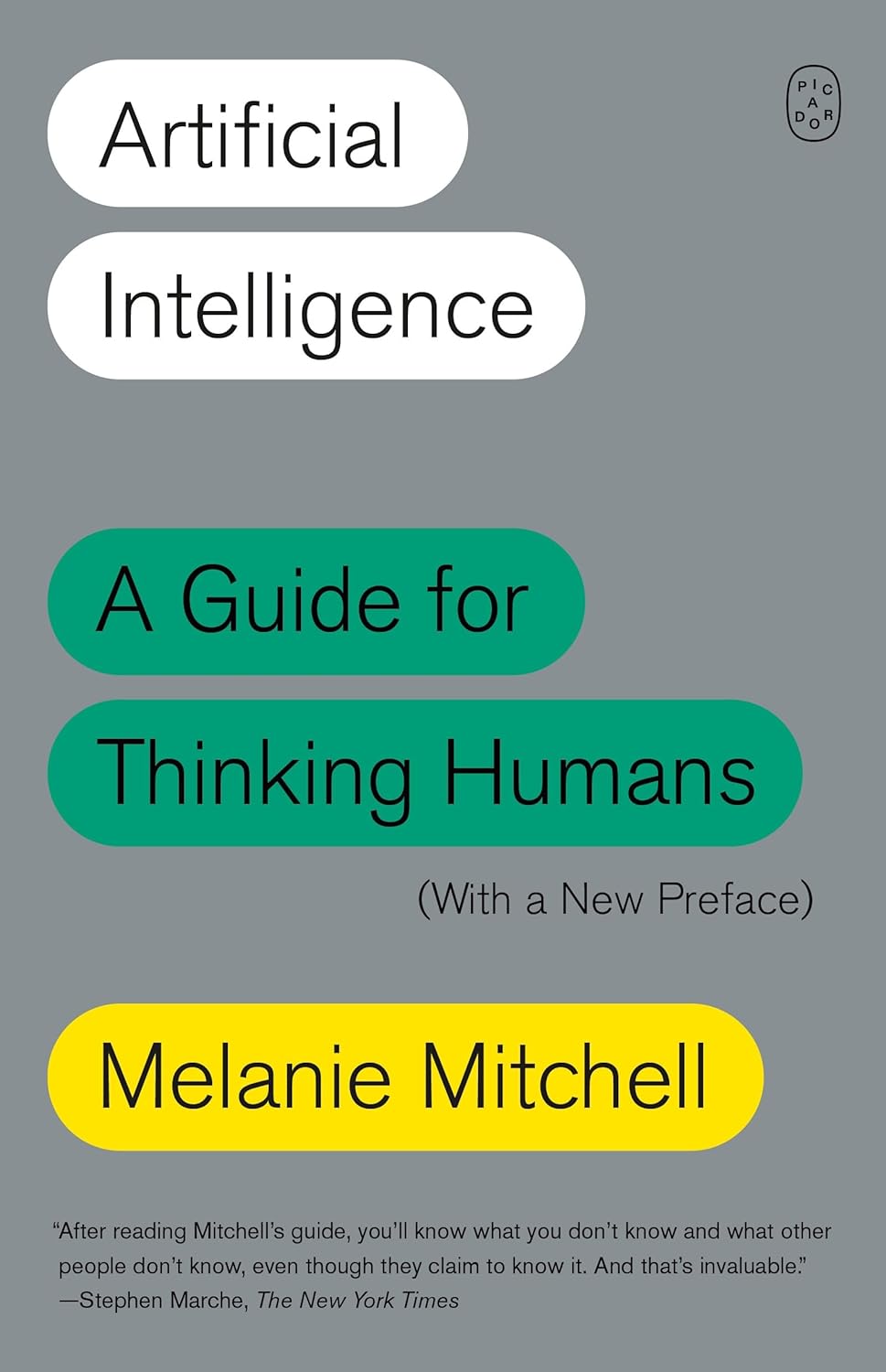
Melanie Mitchell has written the most honest book about artificial intelligence that does not say what it should. Artificial Intelligence: A Guide for Thinking Humans is rigorous, careful, and correct. It documents, with surgical patience, everything that current machines cannot do: they cannot audit plausibility, cannot reason causally, cannot formulate problems they haven't been handed, cannot know that containers have sizes or that "until it was empty" specifies the bottle rather than the cup. Mitchell names the gap between human intelligence and machine performance and refuses to let the industry close it with press releases. This is important work.
It is also incomplete in a way that costs us something.
Because buried in Mitchell's diagnosis is a question she never asks. Not: when will AI reach human level? Not: should we fear superintelligence? The question is this: if machines genuinely cannot do the things Mitchell identifies as mattering most — if they cannot audit plausibility, reason causally, formulate problems, make interpretive judgments — why are we not teaching those things? Her analysis names exactly what education ignores. She does not notice the coincidence. Or she notices it and decides, deliberately, not to follow it home.
That is the book's failure. It is also, I think, a choice.
What Hofstadter Understood That the Engineers Could Not
The book opens with Douglas Hofstadter in 2014, standing before a room of Google engineers, declaring himself terrified. Not of robots. Not of the singularity. Terrified that human creativity might turn out to be "a bag of tricks." A program called EMI had composed Chopin-like mazurkas convincing enough to fool professional musicians at the Eastman School, and Hofstadter did not respond with curiosity. He responded with grief — as if something he had believed about the depth of human minds might turn out to be shallower than he had hoped.
The engineers were baffled by him. Progress was the goal. Hofstadter's terror was unintelligible.
Mitchell spends the rest of the book adjudicating between these two responses. She sides with Hofstadter — not in the terror, but in the insistence that something important is missing. EMI's mazurkas were pattern manipulation. Deep Blue's chess was brute-force search. AlphaGo's moves, which stunned professional Go players worldwide, emerged from millions of self-play games without AlphaGo ever understanding what a game was, what winning meant, or why any of it mattered. Mitchell's argument is that none of these achievements constitute progress toward general intelligence, because general intelligence is not faster pattern matching. It is something else. She calls it understanding, grounds it in causal reasoning and analogical thinking and mental simulation, and concludes that current machines have essentially none of it.
She is right. The Winograd schema results make this undeniable. A machine that scores 61% on problems requiring knowledge that things fall when dropped, that pouring empties containers, that city councils and demonstrators want different things — that machine is not approaching human-level language comprehension. It has learned the syntactic surface of language without acquiring the semantic substrate. The gap is not a matter of scale. It is a matter of kind.
What the Benchmark Hides, and Who Benefits from Hiding It
The book's sharpest section is its treatment of what Mitchell calls the benchmark problem. The pattern is this: a task is defined narrowly, a benchmark is constructed for it, human performance is measured under conditions that favor humans, machine performance is measured under conditions that favor machines, the numbers converge, and the headlines announce parity. SQuAD required answer extraction from passages where the answer was guaranteed to exist — not reading, extraction. ImageNet's top-five accuracy allowed the machine five guesses. The "human" baseline on ImageNet came from a single graduate student who admitted to finding the process unenjoyable after the first 200 images of 1,500. Microsoft's claim of "human parity" in Chinese-English translation rested on evaluations of single isolated sentences from carefully edited news copy — not the colloquial, idiomatic, contextually entangled language that constitutes actual communication.
Mitchell names this pattern without flinching.
What she does not name is who benefits from it. The benchmark problem is not an innocent methodological error. It is a structural convenience. Narrow benchmarks produce favorable headlines. Favorable headlines produce investment. Investment produces the next benchmark. The machinery of AI progress reporting is not optimized for truth. It is optimized for legibility — for the kind of measurement that can be announced at a press conference and understood by people who have not read the paper.
But there is a second beneficiary Mitchell does not name. The education system that optimizes students for benchmark performance is, by her own analysis, training humans to compete on the machine's home turf. Machines are superhuman at pattern retrieval, syntactic manipulation, narrow classification. They are genuinely poor at everything the benchmark cannot measure: judgment, interpretation, causal reasoning, the kind of understanding that answers Winograd schemas. A curriculum that teaches students to locate answers, perform procedures, and produce syntactically correct outputs in standardized formats is teaching students to approximate machine behavior. Mitchell's analysis establishes this exactly. She draws no educational conclusion from it.
That silence is not neutral. Silence, in a book this carefully reasoned, is a choice.
The Gap That Both Education and AI Refused to Cross
Here is what Mitchell identifies as the barriers to machine general intelligence: core intuitive knowledge, mental simulation, abstraction, analogy, causal reasoning, the ability to form new concepts from sparse evidence. Her program Copycat — built on Hofstadter's architecture of active symbols, designed to make analogies in idealized letter-string domains — could not solve problems requiring concepts it had never seen. Double successorship. Extra letters that need deletion. Humans recognize these immediately, without instruction, because we are built — biologically and culturally — to perceive the essence of a situation before we can verbalize it, and to apply what we perceive to novel cases by analogy.
These are precisely the capacities that are not on the test.
The standard curriculum optimizes for fact retrieval, arithmetic accuracy, and syntactic correctness in standardized formats. Students are not taught to ask whether the question is well-formed. They are taught to answer the question. They are not taught to audit the plausibility of a result without recomputing it. They are taught to compute. They are not taught to recognize when a machine is responding to superficial statistical cues rather than semantic content — to recognize, in the terms Mitchell establishes, the pattern of Clever Hans, the horse who appeared to calculate but was actually reading the questioner's body language.
This is not a small gap. It is the entire gap. Mitchell has spent a book documenting what machines cannot do, and what machines cannot do is exactly what students are not taught to do. The two failures share a common root. Both institutions — AI research and formal schooling — defined intelligence as what could be measured, optimized for what could be measured, and called the result progress.
Reading for the Situation, Not the Answer
Mitchell's treatment of natural language is where the evasion costs us most.
She correctly identifies that large language models process language without understanding it. They learn statistical distributions over token sequences. They do not know that restaurants involve transactions, that "bent out of shape" means upset, that the referent of "they feared violence" depends on what city councils do and what demonstrators want. When Google Translate renders "a little too dark for my taste" as "infrequent" and "stooped over," it is not making a careless error. It is revealing that translation requires a mental model of the situation being described, and it has no such model.
This is exactly right.
But here is what Mitchell does not say: the same analysis applies to students trained to read for the answer rather than for the situation. A student who locates a phrase in a passage that matches a question stem is doing what the SQuAD system does — answer extraction, not reading comprehension. The education system that produces SQuAD-style readers has been training students, for decades before the machines arrived, to approximate what machines would eventually do better. Now the machines do it better.
What would it mean to teach reading as the Winograd schema requires it? What would it mean to ask students to track reference — to know that "they feared violence" specifies the city council because of what councils do and what demonstrators want? To know that "until it was empty" specifies the bottle because of how pouring works in three dimensions? This is causal reasoning. It is the capacity Mitchell identifies as central to human intelligence and absent from current AI. It is also almost entirely absent from current curricula.
The two absences are not coincidental. They reflect a common failure to understand what understanding requires.
The Embodiment Hypothesis Points Past the Machine
Mitchell's epilogue gestures toward the embodiment hypothesis: the possibility that human intelligence cannot be separated from the body's history of interaction with the world, that concepts are not abstractions stored in a symbol system but reenactments of sensorimotor experience, that to understand "warmth" is to have been warm. She finds this "increasingly compelling." She quotes Karpathy: perhaps the only way to build systems that interpret scenes the way humans do is to give them structured, temporally coherent experience, the ability to interact with the world.
This is the right intuition. But it points past machines. It points at students.
The student who learned mathematics by retrieving procedures is not the same as the student who learned mathematics by constructing proofs, discovering counterexamples, and explaining why a result that looks right might be wrong. The latter has a mental model of mathematical reasoning. The former has a lookup table. The distinction is not native intelligence. It is a matter of what was asked of them and what counted as success. It is curriculum.
Mitchell's book has documented, rigorously and honestly, the gap between what machines do and what humans can do at their best. She has named the capacities on the far side of that gap. She has explained why they matter. What she has not done is turn the analysis around — to ask what it would mean to build an education system that deliberately cultivated those capacities, that taught plausibility auditing as a discipline, that made causal formulation a first-order skill, that treated analogical reasoning not as a gift but as something that improves with practice and instruction.
The machines are here. The question they force on us is not how to regulate them or fear them or celebrate them. It is simpler and more urgent: what are we going to teach now?
Mitchell's book contains everything necessary to answer that question.
She stops just short of answering it.
That is the limitation of the comfortable pessimist. She is right about everything that matters. She stops precisely where being right makes demands.
SUMMARY
Artificial Intelligence: A Guide for Thinking Humans is among the most rigorous popular accounts of AI's real limitations — and this piece argues that its rigor makes its central evasion inexcusable. Melanie Mitchell correctly identifies what machines cannot do: audit plausibility, reason causally, form concepts from sparse evidence, understand language rather than manipulate its surface. She documents the benchmark problem — the industry's systematic use of narrow measurements to manufacture the appearance of progress — with patience and precision. She sides, rightly, with Hofstadter's insistence that something important is missing from current AI.
And then she stops.
What this piece refuses to let pass: Mitchell's own analysis names, with specificity, the exact capacities that formal education fails to cultivate. The gap between machine intelligence and human intelligence runs precisely through plausibility auditing, causal formulation, interpretive judgment, and analogical reasoning — the capacities that are also almost entirely absent from standard curricula. This is not a coincidence the piece treats lightly. It is a structural correspondence, and it implicates something larger than AI research. The education system that optimizes students for benchmark performance has been training humans to compete on the machine's home turf — to be slower, more expensive approximations of systems that already fit in their pockets.
The reader must reckon with a specific discomfort by the end: Mitchell's pessimism is accurate but safe. It lets us grieve the limits of machines without asking what we've asked of humans. The piece names this as a choice, not an oversight — and insists that anyone who takes Mitchell's diagnosis seriously cannot stop where she did.