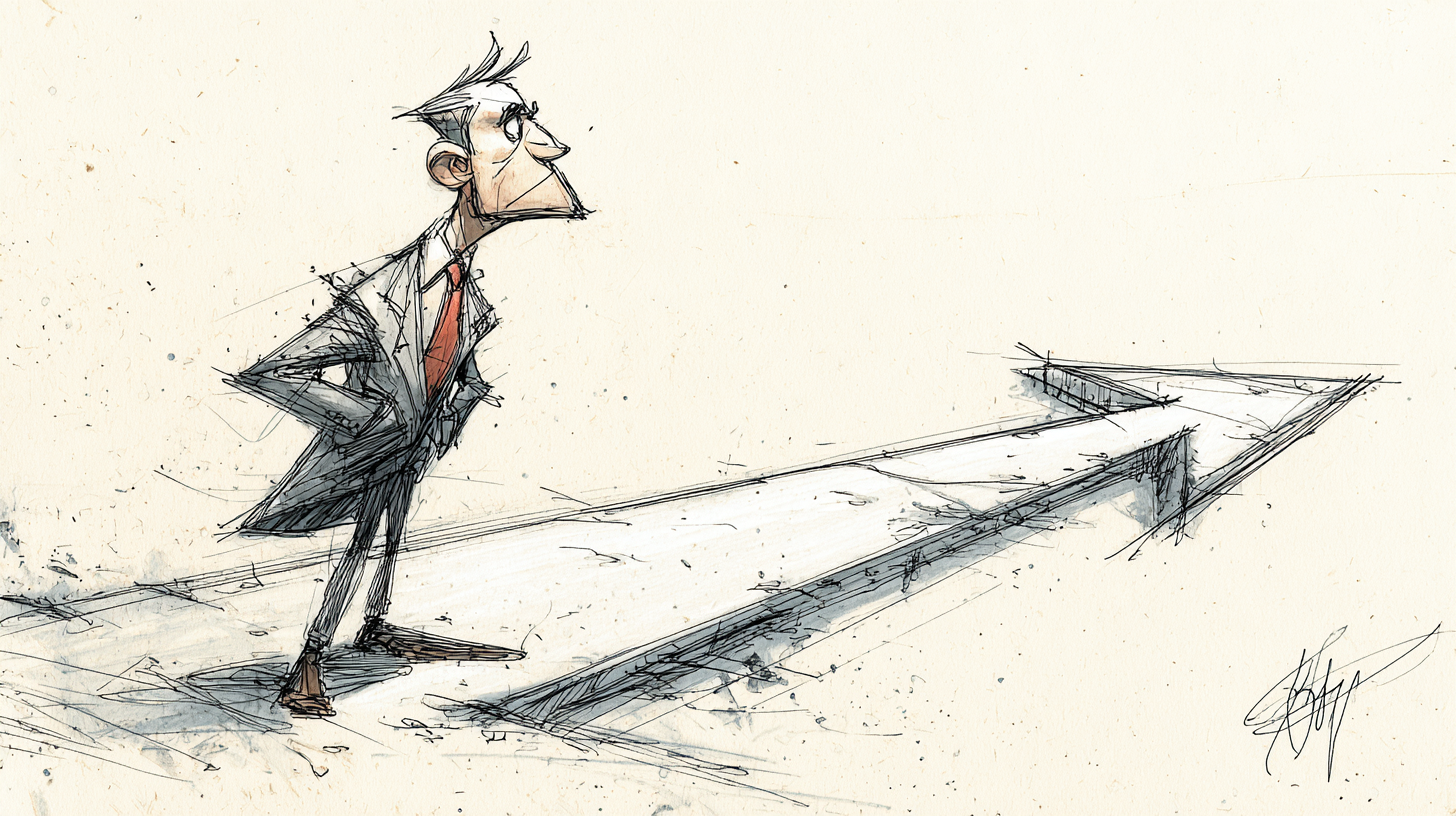
What The Little Review always knew — what made Ulysses prosecutable — is that form determines content as much as content determines form. The architecture precedes the material. You cannot write the stream of consciousness without first assuming the mind has a stream. You cannot publish what violates the architecture without violating the architecture itself. Margaret Anderson and Jane Heap understood this when they serialized Joyce's novel between 1918 and 1920. They understood it again in 1921 when the Society for the Suppression of Vice prosecuted them for the "Nausicaa" episode — not because the episode was false, but because it was true in a form the law could not accommodate. The diagram was wrong. The prose was right. These are not contradictions.
Judea Pearl's causal diagrams are Ulysses for the sciences.
For a century, empiricism wore abstinence as virtue. We would measure correlations. We would build regression equations. We would be honest about our ignorance by refusing the words that mattered: because, makes, produces, moves. This was called rigor. It was cowardice dressed in methodology. The honesty was false because it was incomplete. Every statistical model rests on a diagram — a picture of what causes what, which variables collide, where information flows. The researchers simply drew it in invisible ink. They pretended the diagram did not exist while their entire apparatus depended upon it.
This is not transparency. This is possession without confession.
Pearl's restoration of causal language did not restore innocence. It exposed what was always there: the researcher must choose the diagram before the data can speak. The diagram is not found in nature. It is imposed upon nature. The question becomes: Imposed by whom? By what authority? With what blindness?
What Pearl Actually Proved
Pearl is a computer scientist and philosopher, a Turing Award recipient, a professor at UCLA whose two foundational texts — Causality in 2000 and The Book of Why in 2018 — constitute the most significant restructuring of scientific epistemology since Popper. What he proved, formally and without apology, is that the statistical framework the sciences spent a century building is causally illiterate. It can tell you that two things move together. It cannot tell you — cannot, in principle, using its own tools — which one moves the other.
To answer causal questions, Pearl showed, you need a model of the world before you touch the data. Not after. Before.
He formalized this through the ladder of causation, three rungs of increasing philosophical ambition. The first rung: seeing. What is the probability of Y given that I observe X? This is the domain of statistics, of correlation, of regression. The second rung: doing. What is the probability of Y if I actively intervene and set X to a specific value — Pearl writes this as P(Y | do(X)), and the do-operator is the entire scandal, the notation that separates correlation from cause. The third rung: imagining. What would Y have been if X had been different, in a world where X was not different? Counterfactual reasoning. The thing humans do constantly and the thing no statistical model can do without a causal diagram underneath it.
The do-calculus Pearl developed is a formal language for moving between these rungs. Given a diagram, given certain structural assumptions about how information flows through it, you can calculate causal effects from observational data. You can identify when an experiment is necessary and when it is not. You can detect when your estimate is confounded and specify exactly what additional data would remove the confounding.
The mathematics is extraordinary. Clean, powerful, formally valid.
But here is what the celebrations of Pearl's work persistently obscure: the diagram is not given. The do-calculus tells you what follows from your diagram. It does not tell you whether your diagram is correct. That question — the question of which arrows to draw, which variables to include, which mechanisms to assume — is answered before the mathematics begins. It is answered in the choices that precede rigor.
Pearl gave us the tools to reason clearly within a diagram. He did not, and could not, give us the tools to choose between diagrams. That choice remains what it always was: a political act.
The Pattern That Refuses to Speak
Consider what a causal diagram actually is: a claim about the architecture of ignorance.
When you draw an arrow from X to Y, you are not drawing a fact. You are drawing a boundary. You are saying: beyond this line, I will not look. This mechanism I assume. This pathway I will not question. The rest of the world, I declare irrelevant.
The diagram is a confession of what you refuse to know.
What the current discourse on causal inference misses — what it is constructed to miss — is the dimension of Pattern. When you observe anything in the social world, you observe a pattern: a correlation between variables, a stability across samples, a regularity that persists when you look for it. The pattern is real. It is there. But which diagram do you attach to it?
You could attach several. The pattern does not care which one you choose. The pattern is agnostic. The pattern simply persists.
This is the scandal: a pattern can be perfectly consistent with multiple incompatible causal models. Pearl's mathematics cannot resolve this. No amount of additional data can resolve this, because the resolution depends on assumptions about what lies outside the data — about the diagram itself. The data speaks only within the diagram. Change the diagram, the same data speaks differently. The data never adjudicates between them.
Who decides which diagram gets attached to the pattern? The person who controls publication. The person who controls funding. The person who controls what counts as "rigorous." The person who controls which questions sound reasonable and which questions sound like activism dressed up as science.
Intelligence as a Diagram Wearing a Name
Nowhere is this more clearly visible — nowhere is the violence of the diagram more precisely concentrated — than in the century-long project of measuring human intelligence.
What we call "intelligence" is not a thing. It is a pattern to which we have attached a diagram.
The pattern is real: some people solve certain problems faster than others. Some people learn certain skills more readily. Some people generate novel solutions under time pressure. These patterns exist across cultures and contexts. They can be measured reliably. Their stability over time is well-documented. None of this is in dispute.
But "intelligence" — the unified thing, the essence, the single measurable quantity that underlies all of these patterns — is the diagram we have chosen to attach to them. It is not discovered. It is decided.
The diagram reads, in its canonical form: there is a quantity called g, general intelligence. It underlies all mental performance. It distributes across populations according to certain parameters. It is substantially heritable. Differences in its distribution across demographic groups are, to some meaningful degree, natural rather than constructed. This was Charles Spearman's diagram in 1904. It was Arthur Jensen's diagram in 1969. It was the diagram that structured The Bell Curve in 1994.
Across a century, the diagram remained. The mathematics built on it became more sophisticated. The predictions improved. The correlations stabilized. The apparatus grew impressively rigorous.
The diagram was wrong. The mathematics worked beautifully within it. Both statements are true simultaneously.
A researcher studying intelligence might draw, instead:
That what IQ tests measure is the specific cognitive toolkit developed by literate, formally educated, Western cultures — and that since those cultures control the institutions that reward cognitive performance, scores on these tests predict institutional outcomes not because they measure underlying capacity but because they measure proximity to the culture that designed both the test and the reward system.
Or might draw:
That "general intelligence" is a statistical artifact of factor analysis applied to a battery of tests that were deliberately selected to load on a single factor — that g is not discovered in the mind but constructed in the methodology.
Or might draw:
That the heritable component of measured cognitive performance reflects the heritability of access — to nutrition, to educational resources, to freedom from chronic stress, to environments that develop the specific skills the tests reward — and that heritability within a population says nothing about differences between populations whose environments are not equivalent.
Each of these diagrams is geometrically possible. Each is as mathematically valid, given its assumptions, as the canonical one. Each would be, if accepted, as amenable to Pearl's do-calculus. Each produces different predictions. Each creates a different world if believed.
The question of which diagram is correct cannot be answered by the data, because the data speaks only within the diagram. It can only be answered by the prior question: who has the authority to impose the architecture? And the answer to that question, for the last century, has not been determined by Pearl's mathematics. It has been determined by who controlled the journals, who controlled the funding, who controlled what sounded like science and what sounded like politics — as though the diagram itself were not already politics, already a decision about whose ignorance to institutionalize.
This is what the celebrations of rigor within any given framework always conceal: that the framework is a choice. That the choice has winners and losers. That calling it science does not make it neutral.
What the Mathematics Actually Tells Us
Return to Pearl's achievement, now reframed.
The do-calculus is valid. The ladder of causation is a genuine contribution to how we reason about the world. The formal identification of confounding, the conditions under which observational data can support causal claims, the precise specification of what an experiment can and cannot tell you — these are real and important and they make the sciences more honest about what they know.
But what the mathematics proves — this is what the celebrations keep sliding past — is that causal inference is conditional on the diagram. The theorem does not say: given this data, here is the true causal structure. The theorem says: given this diagram, here is what the data implies about the causal quantities your diagram specifies.
The diagram is the magistrate. The data is the witness. The mathematics is the procedure for taking testimony. And we have spent a century confusing the testimony with the verdict, the procedure with the judgment, the tool with the choice about which question to ask.
Pearl gave us a way to be honest about this. He gave us a formal language for writing down our assumptions before we look at the data, for acknowledging explicitly that we are imposing an architecture and then doing the rigorous work of reasoning within it. This is genuinely more honest than what came before — the invisible ink era, when the diagrams existed but were never drawn, when the assumptions were present but never stated, when the architecture was built before the first data point was collected and then the architecture was called "findings."
The honest use of Pearl's tools requires, first, drawing the diagram where anyone can see it. Stating the assumptions. Inviting the argument about whether those assumptions are correct. Understanding that the argument about the diagram is not a methodological argument — it is a philosophical one, a political one, a question about whose experience of the world counts as evidence for what kind of structure.
The sciences are not yet doing this. They are using Pearl's language to justify greater confidence in conclusions that depend on diagrams they have not examined. This is progress in rigor within the architecture. It is not progress in honesty about the architecture itself.
The Standard We Need to Hold
What a true causal epistemology would look like: it would begin not with "What does this data show?" but with "What diagram have we attached to this pattern? Who attached it? What other diagrams are geometrically possible? What world would each diagram create if we believed it?"
These are not questions the sciences can answer with more data. They are not questions that more rigorous methodology can address. They are questions of choice. Of power. Of architecture.
The Little Review was prosecuted not because the book was wrong but because it was true in a form the law could not accommodate. It refused the acceptable diagram of how consciousness should be rendered. It insisted on a different architecture. Anderson and Heap published it anyway and paid the fine and kept publishing.
The sciences need this refusal. They need researchers willing to say: we have attached a different diagram to this pattern. It is as mathematically valid as the conventional one. It is more honest about what we are choosing to ignore. It is less comfortable. It redistributes explanatory power differently. Here it is, drawn where anyone can see it.
The diagram is transparent. You can see every arrow. You can agree or disagree with every assumption. You can propose a different one.
This is what Pearl actually gave us: not the answer, but the form in which the question must be asked. The answer still requires the thing science has always required and has always most resisted — the willingness to name who is drawing the arrows, and to ask, before the mathematics begins, whether they are drawing them honestly.
The diagram precedes the world. The question is only whether we will be honest about having drawn it — and whether we are prepared to let someone else draw it differently, and look, unflinching, at what changes.
Tags: Judea Pearl causal inference, directed acyclic graphs epistemology, intelligence testing g factor critique, causal diagram political authority, do-calculus limits of statistics
Comments
No comments yet.
Sign in to comment.