The Architecture Is Immaculate. The Occupant Is Still Missing.
Douglas Hofstadter has written the most persuasive account of what a self is — and a book that cannot bring itself to answer why a self should feel like anything at all.
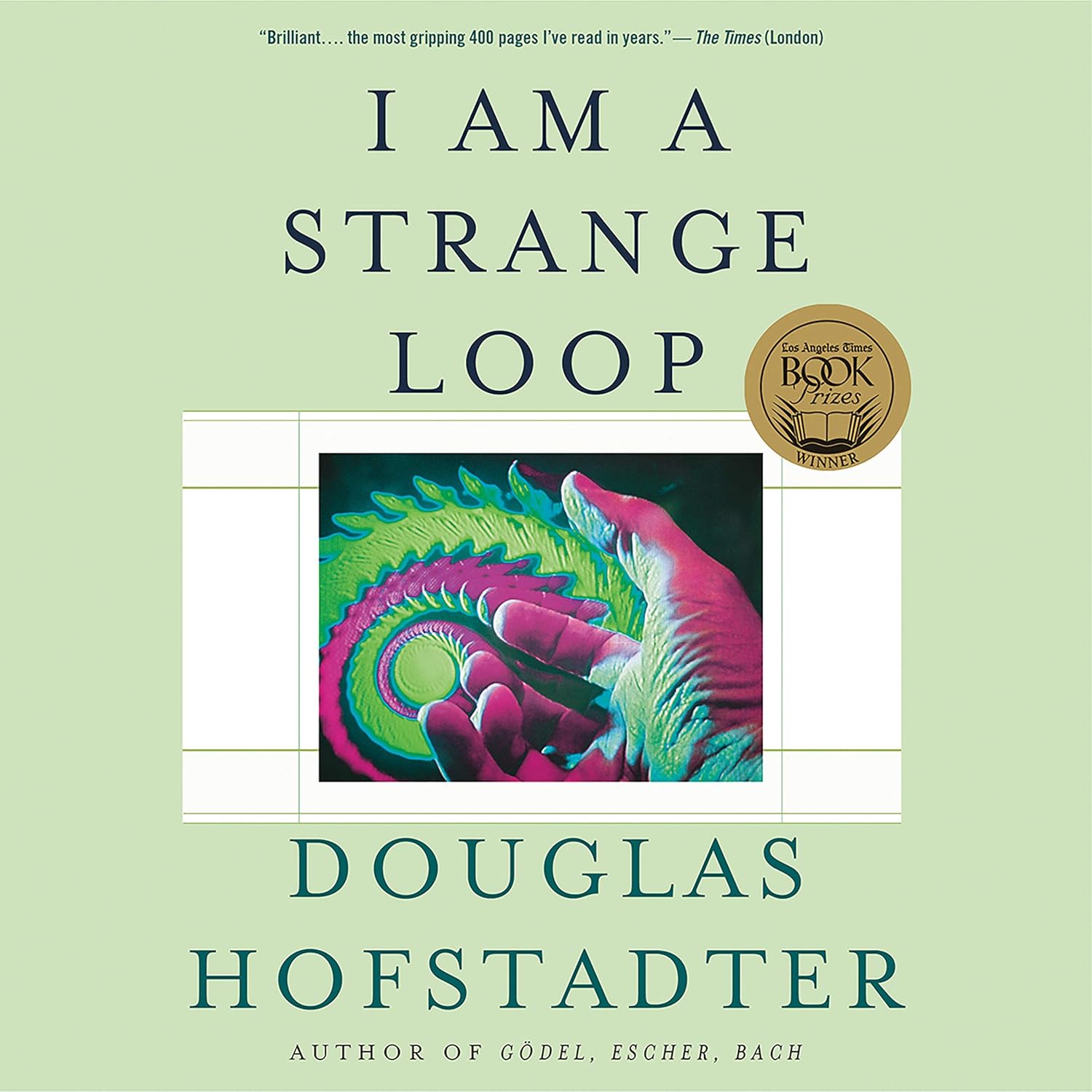
Douglas Hofstadter is braver than most philosophers. He looks directly at grief, at mortality, at the question of what survives when someone you love stops existing. He does not flinch. He builds an argument about consciousness from Gödel's incompleteness theorems up through the structure of human identity and out into what it means to carry another person's self inside your own brain. The argument is beautiful. It is coherent. It is almost certainly right about what a self is.
It does not answer what a self is like.
That distinction — between the architecture of selfhood and the experience of it — is the hardest problem in philosophy of mind. Hofstadter knows it is there. He names it, then sidesteps it, then names it again, then sidesteps it more elegantly. By the end of I Am a Strange Loop, he has given us the most illuminating account of personal identity produced by a non-philosopher in fifty years, and he has done something that requires more intellectual honesty to acknowledge than most readers of this book will be comfortable with: he has described the machinery with extraordinary precision while leaving the person inside the machinery entirely unexplained.
That gap is not a failure of this book specifically. It is the unsolved problem at the center of an entire field. But Hofstadter set himself an ambitious target, and intellectual honesty requires naming what he hit and what he missed.
What He Got Right, and Why It Matters
Start with the achievement, because it is genuine and considerable.
Hofstadter's most important contribution is the argument that the self is a natural object. Not an anomaly. Not a ghost requiring special metaphysical treatment. Not a Cartesian theater where some homunculus sits watching the show. A self arises in a brain the same way a Gödel sentence arises in a formal system: any system powerful enough to represent abstract patterns is, by that same power, capable of turning representation on itself. The strange loop is not imported from outside. It is generated from within, by the system's own richness.
This insight has three consequences Hofstadter draws correctly — and which most people, including most philosophers, are not willing to follow to their conclusions.
First: selves come in degrees. If selfhood is a matter of how richly and recursively a system represents itself, it is a continuous variable, not a binary switch. A mosquito has negligible self-representation. A dog has moderate. A human adult has extensive. The moral implications are uncomfortable and correct: some lives matter more than others, not in a way that licenses cruelty, but in a way that should change how we think about the animal-human boundary, about what death costs, about whose suffering counts and how much. Hofstadter states this more plainly than almost any philosopher dares.
Second: selves are distributed. If the self is a pattern that can be instantiated in one brain's substrate, it can be instantiated at lower resolution in another. When you model another person deeply and over many years, a coarse copy of their strange loop lives in your brain. They exist in you, partially. This is not metaphor. It is a consequence of the functionalist picture of mind that follows from the strange-loop argument. Hofstadter applies it to grief — to the question of whether Carol survives in the brains of those who knew her — and the argument is philosophically coherent even where it is emotionally devastating.
Third: Gödel's theorem is not a trick. The sequence from Gödel numbering to the construction of a self-referential unprovable sentence is the clearest exposition available for readers without formal training, and it preserves what is philosophically essential. KG — the Gödel sentence that says of itself that it cannot be proved — arises not from sleight of hand but from the system's own power. Any system that can model arithmetic can model itself. Any brain that can model the world can model itself. The parallel is structural, not merely decorative.
The Evasion, Named Precisely
The book's central evasion is best approached through the question Hofstadter himself poses most urgently: if Carol's strange loop is partially instantiated in his brain, does she still experience anything?
His friend Dennett answers that Carol will be thinking with Hofstadter's brain. The answer is poetic. It is possibly true. It does not address the question. The question is not about thinking. It is about experiencing. And if we cannot answer it for the copy in Hofstadter's brain, we have not answered it for Hofstadter's own strange loop either. We have explained the structure of the self without explaining why structure should generate something it is like to be.
Hofstadter's response to the Hard Problem — the problem of why physical processes give rise to subjective experience at all — is that the problem is generated by a category error. We imagine consciousness as something added onto physical organization rather than constituted by it. A philosophical zombie — a creature physically identical to a human but with no inner experience — is not genuinely conceivable, he argues, because there is nothing to consciousness over and above its functional organization.
This is probably correct. The dismissal is too quick.
The word "symbol" is doing enormous philosophical work throughout this book, and the work it is being asked to do is precisely the work of bridging structure to experience. When Hofstadter says that symbols have meaning because they reliably track patterns in the world, he is offering a third-person account. It tells us when we are entitled, from the outside, to attribute meaning to a system. It does not tell us what it is like to be the system from the inside. The gap between a system that reliably tracks patterns and a system that experiences tracking patterns is the gap the book cannot cross. It names the gap. It gestures at the gap. Then it argues that the gap is an illusion generated by confused thinking.
Maybe it is. But the argument that the gap is illusory would need to be demonstrated, not asserted. And Hofstadter asserts it.
The Analogy That Proves Too Much
Here is the philosophical problem that the book's elegant central analogy creates and does not resolve.
KG does not experience anything. It is not like anything to be KG. The Gödel sentence refers to itself, generates an unprovable truth, demonstrates the strange loop at the heart of formal systems — and has no inner life whatsoever. If the analogy between Gödel's strange loop and the brain's strange loop is as precise as Hofstadter claims, then the self is also a strange loop that generates interesting structural properties without thereby generating experience. The analogy, taken seriously, supports exactly the conclusion Hofstadter most wants to resist.
The way to resist this conclusion is to say that the brain's loop is implemented in a system already capable of generating conscious states from below — the way the stomach causes digestion, through specific causal properties of biological tissue — and that no amount of functional reorganization in a different substrate can replicate this. This is biological naturalism. Hofstadter explicitly rejects it, arguing that carbon-chauvinism is as arbitrary as any other substrate-chauvinism.
He may be right. But the rejection is too fast. The relevant question is not about carbon per se. It is about causal powers: whether the causal structure that generates consciousness can be reproduced by any system with the right functional organization, or whether it depends on specific physical properties of biological tissue. That is an empirical question about neuroscience. We do not know the answer. The honest position is to say so, not to dismiss the question as confused.
What He Gave Us and What He Owed Us
I Am a Strange Loop is the most important book on consciousness produced by a non-philosopher in the last half century. That is both high praise and a complaint. Hofstadter has given us the most compelling functionalist account of personal identity. The most honest treatment of consciousness as a continuous variable. The most philosophically coherent account of what it means for someone to survive in the minds of those who loved them. He has written a book about grief that is also serious metaphysics, which is nearly impossible and which he has nearly pulled off.
What he has not given us is an account of why any of it feels like anything.
That gap is not unique to this book. It is the gap at the center of consciousness studies, the place where explanation runs out and the hard problem sits, patient and unresolved. But a book this ambitious — one that takes Gödel's incompleteness theorems as its entry point into an argument about what survives death — owes its readers a cleaner acknowledgment that the central question remains open. That the strange loop explains the architecture of the self without explaining the occupant. That the occupant is what the mystery is actually about.
Hofstadter built the most beautiful model of the house. He described every room with precision and care.
He could not tell us who is living there.
SUMMARY
This piece treats I Am a Strange Loop not as a book to be summarized but as a philosophical performance to be held accountable — for what it achieves, which is considerable, and for what it evades, which is the central question the book poses and cannot answer. The argument is not that Hofstadter is wrong. It is that he is right about the architecture of the self and silent, in a way that requires naming, about the experience of it.
The achievement section does not flatter — it follows the argument to its uncomfortable conclusions, the ones Hofstadter himself draws and that most readers prefer to leave untouched: that selves come in degrees, that some lives matter more than others by the logic of the strange-loop picture, that the boundary between human and animal is not a metaphysical threshold but a continuous gradient. The book is braver than its readers, and the piece says so.
The evasion section names precisely where the argument stops short: the gap between a system that reliably tracks patterns and a system that experiences tracking them. The word "symbol" is doing the bridging work throughout Hofstadter's account, and the bridge is not load-bearing. The third-person, observer-relative account of meaning does not tell us what it is like to be the system from the inside. Hofstadter dismisses the Hard Problem as confused thinking. The piece argues that the dismissal needs to be demonstrated, not asserted — and that it isn't.
The analogy section names the problem the book's own central metaphor creates: KG does not experience anything. If the Gödel analogy is as precise as Hofstadter claims, it supports the conclusion he most wants to resist. The reader is left holding the disanalogy and asked to reckon with what it means for the rest of the argument. The piece ends where the book ends — with the machinery described and the person inside it still unaccounted for. That is the honest verdict. It is also, in its own way, the book's.